What keeps organisms alive
The three ideal concepts of sustainability include the encouragement of biodiversity, the dependence on solar energy, and lastly chemical cycling. These three principles refer to systems that occur within the environment naturally. In other words, in order for the earth to preserve and maintain its natural resources it relies on the practice of these sustainability concepts. In most cases these three principles work hand in hand with each other; they influence the success of one another. For example, a very essential ecosystem that represents our earth’s biodiversity is forests. Forests hold one of the most diverse ecosystems; organisms very from being consumers, producers, and decomposers. These three types of organisms are vital to the overall well being of the environment. Every ecosystem requires a producer, which refers to an organism that uses photosynthesis to produce their own energy and nutrients. These producers are later eaten by other organisms who are unable to produce their own food and nutrients. These organisms who rely on the producers are called consumers. Lastly, we have decomposers, which are organisms that decompose organic material or substances. All these forms of organisms are essential in an ecosystem in order to create a balance. Without this biodiversity, there would not be a healthy ecosystem that provides us with clean water, purified air, nutrients to consume etc. Since the beginning of time, most developed county’s rely on selling resources for profit. In other words, my country’s use their natural resources to gain profit. Due to this high demand of land for livestock or trees, deforestation has occurred. The wiping out of forests in order to use that land or resources has negatively affected the environment. By eliminating trees and the organisms of this ecosystem, issues relating to the nutrient cycle occur. By eliminating the trees the phospurus levels in the soil slowly diminish and these greatly impacts the growth of plants and other organisms. This process further prevents natural resources from renewing in a timely manner. Also, a very interest fact stated in the textbook is that a forest that has been wiped out retains significantly less water than a forest that has been untouched. This later affects the amount of nutrients the soil can retain. The wiped out land will retain less water and less nutrients making it more difficult for the natural resources to renew themselves. I mentioned the biodiversity and nutrient cycling and solar energy of the forest because I noticed an interesting connection. Without the biodiversity of an ecosystem, organisms such as consumers and decomposers will not be able to receive the proper energy and nutrients they need. Furthermore, without the biodiversity and energy absorption of producers there would be no nutrient cycling. Each principle of sustainability naturally works together to efficiently create a system that effectively uses the natural resources in this earth with moderation.
Another very interesting concept introduced was the explanation for what keeps organisms alive. There are four important components of earth that allow organisms to survive and function. These components include the air, soil and sediments, living things and water. These aspects of earth are referred to as the atmosphere, geosphere, biosphere, and hydrosphere. First off, the atmosphere refers to the top layer of the earth that contains most of the air on earth. However, this is not the air that influence the everyday lives of organisms. Further within the atmosphere is the troposphere. The troposphere contains the air organisms need to survive, in other words this part of the earth consists mainly of nitrogen and oxygen. In relation to these chemicals needed to breathe, a small portion of the troposphere conatins chemicals that are part of the greenhouse affect. Interestingly enough, without the emission of these gasses the earth would be too cold for organisms to survive. Therefore, with the help of these gas emissions, the earth warms up enough for living organisms to survive. Another very important aspect of the atmosphere is the stratosphere. In t brief, layer of the atmosphere provides protection from the UV rays of the sun. What clarified this definition was the metaphor the textbook provided by comparing the stratosphere to sunscreen. Secondly, the most vital part of plant regrowth is the soil. Soil is the outermost layer of the geosphere. Majority of the geosphere is in the innermost part of the earth. However, most of the resources that the geosphere provides living organisms is mainly on the top layer and it consists of mostly nonrenewable resources. This refers to the minerals and nutrients provided by the soil and fossil fuels used to produce energy. Next, the biosphere refers to all the living organisms on earth. What was surprising to me was that this part of the earth accounts for a significantly small part of it. All life on earth can be found is all these four components of earth. Lastly, the hydrosphere refers to all the bodies of water on earth. Most of earth consists of water, therefore, according to the Miller, the water is made up of 71% water. Due to earth’s immense amount of water, this natural resource can vary in condition. In other words, water can be found is a variety of different states such as water vapor, liquid water, and ice.
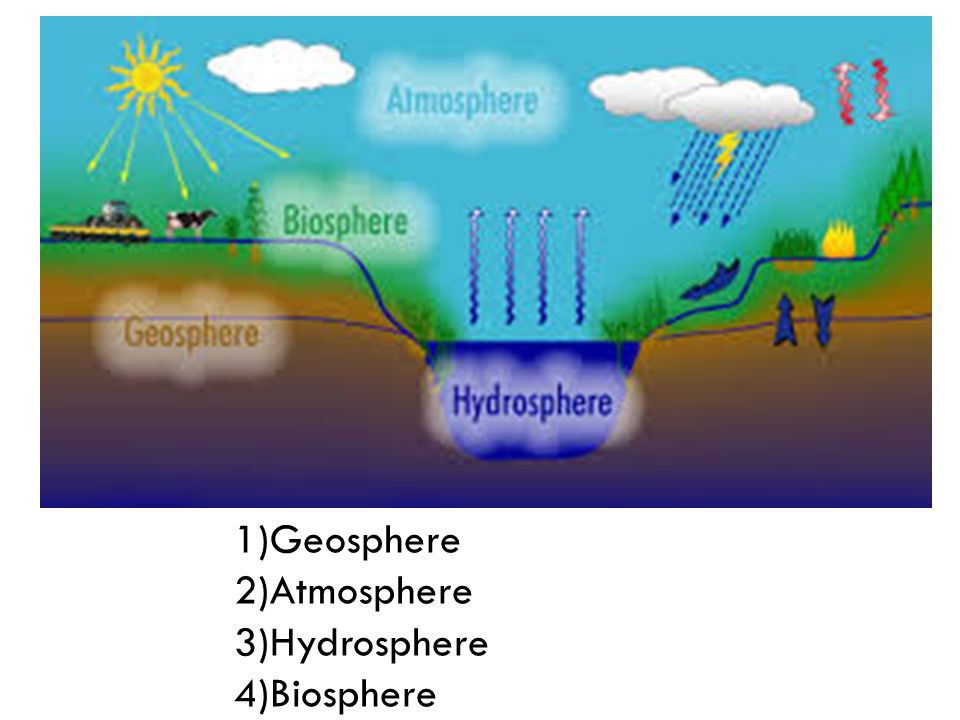
Not only are these four components of earth essential for the everyday lives of all organisms, but they allow natural processes to occur. By this, I am referring to natural cycles that help sustain the environment’s resources. There are a variety of natural cycles that occur on earth. One of these natural cycles includes nutrient cycling. In order for nutrients to transport through the earth to reach all organisms, it needs transportation mediums such as the air, water, soil, and living organisms. When these natural processes occur, there tends to be an abundance of nutrients that are stored in certain parts or layers of the earth (geosphere, hydrosphere etc.). These storage of nutrients refers to the reservoirs of the earth. Next, there is the phosphorus cycle, and this process primarily occurs in the geosphere, hydrosphere, and biosphere. Phosphorus is an important nutrient that is needed by all organisms especially producers, who absorb this nutrient to produce energy and encourage growth. Phosphorus, for the most part, remains in the soil, but when it is being transported, it uses natural resources such as living organisms and water. Living organisms consume this nutrient and later produce waste that allows this nutrient to return to the soil. Water on the other hand, passes over soil and encourages the erosion of the soil and the transportation of phosphorus from one part of the earth to another. This later encourages the absorption of the nutrient elsewhere. Lastly, I have not mentioned the atmosphere because this part of the earth plays no role in the cycling of phosphorus. This nutrient primarily stays on earth and is unable to be transported by the air. Besides these two cycles I have just mentioned, there is also four other cycles that are mentioned in the texts that are vital to the environment’s overall well being. These cycles include the sulfur, nitrogen, carbon and water cycle. These cycles are clear demonstrations of how the earth’s components are major influencers of the recycling and maintenance of its natural resources.
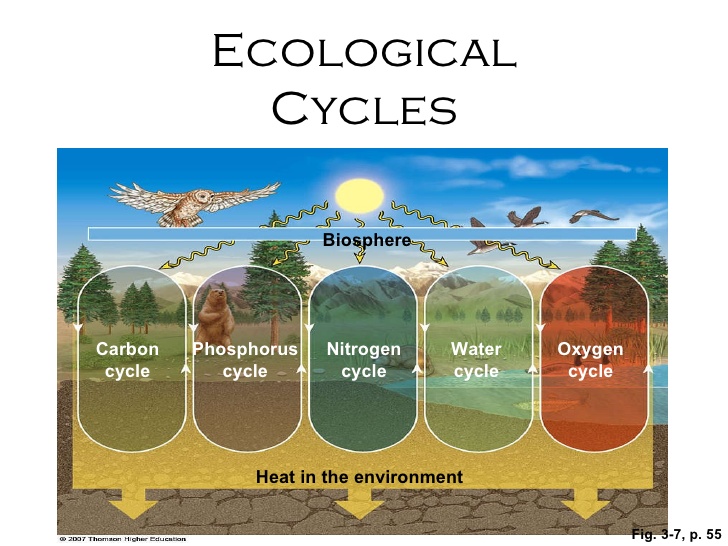
If one of the earth’s most diverse ecosystem (the forest) represents a small portion of the earth…. How is it enough to sustain earth now?
Word Count: 1246
Brandeis High School. “Ecological Cycles.” LinkedIn SlideShare, 19 July 2010, http://www.slideshare.net/mccracken/ecological-cycles.
Miller, G. Tyler, and Scott Spoolman. Living in the Environment. Cengage Learning, 2015.
“THY DYNAMIC EARTH Geosphere, Atmosphere, Hydrosphere & Biosphere. – Ppt Download.” SlidePlayer, SlidePlayer, slideplayer.com/slide/9512189/.

 Liz's Blog